Roses are red, nerves carry sparks, tumors love shortcuts, especially after dark. The PubMed item here is a Q&A, but the real action sits one click behind it: Hua Zhong's group just mapped a weird little route small cell lung cancer seems to use when it wants to get cozy with nerves - and by "cozy," I mean "bad for everyone involved" Zhou et al., 2026.
Small cell lung cancer, or SCLC, is the fast, nasty, sprinting cousin of lung cancer. It tends to grow quickly, spread early, and generally behave like it has a personal grudge against calendars and treatment plans. A recent JAMA review puts the 5-year overall survival in a bleak range, depending on stage and setting, which tells you this disease does not enjoy being managed politely (Kim et al., 2025).
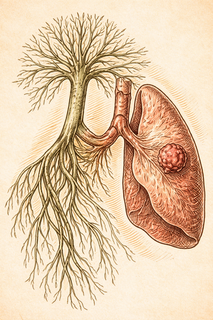
The Tumor Found a Side Door
The new Cell Reports paper focuses on perineural invasion. That means cancer cells are not just spreading through blood or lymph. They are moving into the space around nerves. Think less "random wandering" and more "using the maintenance tunnels under the city." Creepy? Yes. Biologically efficient? Also yes.
Zhong's team looked at surgically resected SCLC samples and found that perineural invasion tracked with worse outcomes. Then they dug into mechanism, because cancer papers without mechanism are basically just gossip with p-values. Their answer: the neural microenvironment pushes SCLC cells to crank up STMN2, a neuron-associated protein. That, in turn, boosts the beta-alanine pathway, raising intracellular beta-alanine and helping the cancer cells migrate and invade nerves more effectively (Zhou et al., 2026).
That is the plot twist. A protein usually associated with neurons gets repurposed by a neuroendocrine cancer, and a small metabolite helps power the invasion program. Cancer loves stealing the staff badge and walking through the side entrance.
Why This Is More Than a Lab Curiosity
SCLC already has a strong neural identity. It arises from pulmonary neuroendocrine cells, so it is not exactly a stranger to nerve-like behavior. Recent reviews have hammered home that SCLC is biologically plastic, meaning it can shift states, adapt, and become even more annoying under pressure (Sen et al., 2024); (Redin et al., 2024).
And the nerve connection is not just metaphorical. It is becoming literal.
A 2025 Nature paper showed that neuronal activity can directly drive SCLC growth, with tumor cells forming bona fide synaptic interactions in the brain and responding to neural signals (Savchuk et al., 2025). Another 2024 study in Cancer Discovery found that sympathetic neurons can promote SCLC through the beta-2 adrenergic receptor (Fnu et al., 2024). So Zhong's work fits into a much bigger picture: SCLC is not just sitting near nerves. It appears to be taking notes from them, borrowing their tools, and possibly raiding the minibar.
Tiny Molecule, Big Trouble
Beta-alanine is not a celebrity metabolite. It does not get the press glutamine gets. It is more like a character actor who suddenly turns out to be running the heist. In this paper, beta-alanine seems to support the invasive behavior that lets SCLC push into nerve-rich territory (Zhou et al., 2026).
Why does that matter? Because metabolism is druggable. Not always easily. Not always cleanly. But if a tumor depends on a specific metabolic adaptation to invade nerves, that is a vulnerability, not just a science trivia card.
It also helps explain why SCLC can be so aggressive in real tissue, not just in cell culture slides that look calm and innocent. The neighborhood matters. Nerves are not passive bystanders here. They may be active enablers.
The Clinical Catch, Because There Is Always One
This does not mean patients should expect a nerve-blocking or beta-alanine-targeting treatment next Tuesday. SCLC has a long history of making promising biology look foolish in the clinic. The disease is heterogeneous, highly adaptive, and often immunologically "cold," meaning the immune system does not exactly flood the scene like an action movie cavalry (Nabet et al., 2024).
Still, this line of work matters because it sharpens the target list. Instead of just saying "SCLC is aggressive," researchers can now ask a better question: which tumors are using nerve-related programs, which patients have perineural invasion risk, and can that axis be blocked before the cancer turns the nervous system into its personal Uber?
That is a far more useful question. Also a more insulting one, if you are the nervous system.
References
Zhou Y, Zhang R, Yang Y, et al. Regulation of neuronal invasion of small cell lung cancer by STMN2/beta-alanine-controlled metabolic reprogramming. Cell Reports. 2026;45(4):117208. https://doi.org/10.1016/j.celrep.2026.117208
Kim SY, Park HS, Chiang AC. Small Cell Lung Cancer: A Review. JAMA. 2025;333(21):1906-1917. https://doi.org/10.1001/jama.2025.0560
Sen T, Takahashi N, Chakraborty S, et al. Emerging advances in defining the molecular and therapeutic landscape of small-cell lung cancer. Nature Reviews Clinical Oncology. 2024;21:610-627. https://doi.org/10.1038/s41571-024-00914-x
Redin E, Quintanal-Villalonga A, Rudin CM. Small cell lung cancer profiling: an updated synthesis of subtypes, vulnerabilities, and plasticity. Trends in Cancer. 2024. https://doi.org/10.1016/j.trecan.2024.07.008
Savchuk S, Gentry K, et al. Neuronal activity-dependent mechanisms of small cell lung cancer pathogenesis. Nature. 2025. https://www.nature.com/articles/s41586-025-09492-z
Fnu T, Shi P, Zhang W, et al. Sympathetic Neurons Promote Small Cell Lung Cancer Through the Beta-2 Adrenergic Receptor. Cancer Discovery. 2024. https://doi.org/10.1158/2159-8290.CD-24-0718
Nabet BY, et al. Immune heterogeneity in small-cell lung cancer and vulnerability to immune checkpoint blockade. Cancer Cell. 2024. https://doi.org/10.1016/j.ccell.2024.01.010
Disclaimer: The image accompanying this article is for illustrative purposes only and does not depict actual experimental results, data, or biological mechanisms.