ILC2 stands for group 2 innate lymphoid cell. Basically, these are tissue-resident immune cells that hang out at barrier sites like the lungs and gut, where they normally help with parasite defense, allergic responses, and tissue repair. In other words, they are part medic, part alarm system, part neighborhood watch - which is a great setup until a tumor moves into the neighborhood and starts rewriting the house rules.
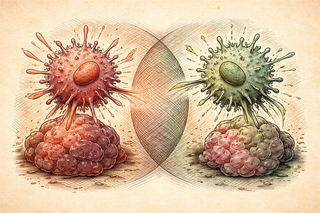
The review by Ciancaglini and colleagues in Journal for ImmunoTherapy of Cancer walks through the big headache in this field: ILC2s do not behave like neat little heroes or villains. In some cancers, they seem to help anti-tumor immunity. In others, they help build a cozy little swamp of immune suppression where the tumor can put its feet up.
That contradiction is not sloppy science. It is biology being biology, which is to say, dramatic and impossible to manage.
Sometimes they help. Sometimes they absolutely do not.
On the anti-tumor side, ILC2s can act like local hype staff for the immune system. In melanoma models, activating ILC2s with IL-33 helped recruit eosinophils and strengthened tumor control, and blocking PD-1 appeared to take the brakes off those ILC2s even further (Jacquelot et al., 2021). A shorter 2022 review in Cellular & Molecular Immunology summarized similar evidence and noted that high ILC2 and IL-33 signatures can line up with better outcomes in some settings (Li et al., 2022).
There is also evidence that ILC2s can help wake up CD8 T cells, the classic tumor-killing celebrities. A 2025 Cancer Research paper reported that type 2 innate lymphoid cells can cross-present tumor antigens to CD8 T cells, which is an unexpectedly fancy move for cells that most people outside immunology have never heard of (Kang et al., 2025). Plot twist: the "supporting cast" may sometimes hand the lead actor the script.
But then cancer does what cancer always does and makes everything messier. In other contexts, ILC2s can push the tumor microenvironment toward immune suppression. A 2021 Nature Communications study showed that PPAR-gamma supports IL-33-dependent pro-tumor ILC2 functions (Ercolano et al., 2021). And just this year, another Nature Communications paper in bladder cancer found that nerve growth factor from mast cells can drive ILC2s toward pro-tumoral behavior, helping build a microenvironment friendlier to the cancer than to the patient (Falquet et al., 2026).
So no, ILC2s are not "good" or "bad." They are more like talented freelancers taking jobs from whoever is paying in cytokines.
Why the checkpoint angle matters
This is where the review gets especially interesting. We usually talk about immune checkpoints like PD-1 and CTLA-4 as brakes on T cells. Fair enough. That is the blockbuster franchise. But ILC2s can express checkpoint molecules too, which means checkpoint therapy may be reshaping more of the tumor ecosystem than we thought.
If that holds up, it matters for two reasons.
First, it could help explain why checkpoint inhibitors work spectacularly in some tumors and face-plant in others. The tumor microenvironment is not just a battlefield between cancer cells and T cells. It is more like a chaotic group project where half the cells did not read the assignment and one of them is actively helping the tumor hide the slides.
Second, it opens the door to smarter combinations. If certain ILC2 states help recruit helpful immune cells, maybe we can amplify that. If other ILC2 states feed suppression, maybe we can block or reprogram them. The broader immunotherapy field is already obsessed with turning "cold" tumors into "hot" ones, meaning getting more effective immune activity inside tumors. ILC2s may turn out to be one of the thermostat knobs.
Why you should care even if you do not spend weekends reading immunology papers
The real promise here is not that ILC2s are the next magic bullet. Cancer biology does not do magic bullets. It does 47 interacting pathways and then laughs when you ask for a summary.
The promise is that this review sharpens the map. It says: stop thinking only about T cells, and pay attention to the tissue-resident immune cells already living inside the tumor's zip code. If researchers can figure out when ILC2s help and when they sabotage the response, that could lead to better biomarkers, better combinations with checkpoint drugs, and maybe fewer patients getting therapies that were never going to work for their tumor's immune ecosystem in the first place.
Basically, ILC2s may be less like random background noise and more like backstage crew controlling the lights.
References
- Ciancaglini C, Santopolo S, Vacca P, Moretta L, Quatrini L. ILC2s and their immune checkpoints in the antitumor response. Journal for ImmunoTherapy of Cancer. 2026. DOI: https://doi.org/10.1136/jitc-2025-014183
- Li Z, Sun H, Gu Z, et al. Emerging roles of ILC2s in antitumor immunity. Cellular & Molecular Immunology. 2022;19:1311-1313. DOI: https://doi.org/10.1038/s41423-022-00918-6
- Jacquelot N, Seillet C, Wang M, et al. Blockade of the co-inhibitory molecule PD-1 unleashes ILC2-dependent antitumor immunity in melanoma. Nature Immunology. 2021;22(7):851-864. DOI: https://doi.org/10.1038/s41590-021-00943-z
- Ercolano G, Gomez-Cadena A, Dumauthioz N, et al. PPARγ drives IL-33-dependent ILC2 pro-tumoral functions. Nature Communications. 2021;12:2538. DOI: https://doi.org/10.1038/s41467-021-22764-2
- Falquet M, El Ahanidi H, Gomez-Cadena A, et al. Mast-cell derived nerve growth factor drives ILC2 pro-tumoral functions in bladder cancer. Nature Communications. 2026;17:3061. DOI: https://doi.org/10.1038/s41467-026-69841-y
- Kang Y, et al. Antigen Cross-Presentation by Type-2 Innate Lymphoid Cells Facilitates the Activation of Antitumor CD8+ T Cells. Cancer Research. 2025. DOI: https://doi.org/10.1158/0008-5472.CAN-24-4194
Disclaimer: The image accompanying this article is for illustrative purposes only and does not depict actual experimental results, data, or biological mechanisms.