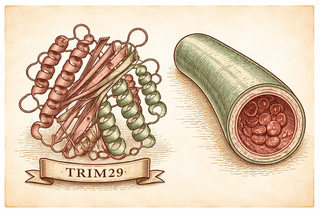
Cells break rules. That's basically the thesis statement for cancer biology, but pancreatic cancer cells have apparently been running an especially sneaky operation - and researchers just caught one of the key players red-handed.
A team led by Long Liu, Zhenzhen Gao, Qi Wang, and colleagues just dropped a paper in Molecular Cancer that reads like a crime thriller set inside your pancreas. The villain? A protein called TRIM29. The crime? Helping pancreatic tumors break into nearby blood vessels - a process called microvascular invasion, or MVI - which is basically cancer's way of booking a first-class ticket to spread through your body.
So What's TRIM29's Deal?
TRIM29 belongs to the TRIM family of proteins - think of them as the cell's quality control inspectors. Most of them tag other proteins for destruction using a process called ubiquitination (slapping a molecular "please recycle" sticker on things). TRIM29 is a bit of an oddball in its family because it lacks the usual RING domain that most TRIM proteins use, but it still manages to pull off ubiquitination tricks through other means (Hatakeyama, 2017).
In pancreatic cancer, TRIM29 has already been caught stabilizing a protein called YAP1, basically keeping a growth-promoting signal cranked up to eleven (Song et al., 2021; PMCID: PMC8340474). It shows up in about 66% of pancreatic tumor samples while being conspicuously absent from normal tissue next door. Not exactly subtle.
The New Heist: IκBα Gets Whacked
Here's where the new study gets really interesting. The researchers found that TRIM29 targets a protein called IκBα for K48-linked ubiquitination. Translation for humans: TRIM29 slaps a specific destruction tag on IκBα, sending it to the cellular recycling bin.
Why does that matter? Because IκBα is basically the bodyguard for your cell's self-control. It sits on top of NF-κB - one of the most powerful inflammatory signaling pathways in your body - and keeps it locked down. When TRIM29 destroys IκBα, NF-κB breaks free, storms into the nucleus, and starts flipping switches that promote inflammation, survival, and invasion (Taniguchi & Karin, 2018).
Think of it this way: IκBα is the designated driver, NF-κB is your friend who wants to start texting exes at 2 AM, and TRIM29 just shoved the DD out of the car.
The CXCL5 Connection
The study zeroed in on a specific subset of epithelial cells marked by CXCL5 expression. CXCL5 is a chemokine - a molecular "come here" signal - that's been linked to drawing immune cells into the tumor neighborhood. But in this case, these CXCL5-positive epithelial cells appear to be the specific stage where TRIM29 pulls its NF-κB stunt, driving the epithelial-to-mesenchymal transition (EMT) that lets cancer cells go from "sitting still" to "on the move."
EMT is basically a cancer cell's glow-up from a stationary brick in the wall to a mobile, invasive troublemaker. And TRIM29 is apparently handing out the running shoes.
Why Microvascular Invasion Matters (A Lot)
Here's the grim math: microvascular invasion shows up in roughly half of all surgical pancreatic cancer cases, and it's one of the strongest predictors of a bad outcome (Defined & Peparini, 2021; PMCID: PMC8378224). Pancreatic cancer already has one of the lowest survival rates of any major cancer - around 13% at five years. When tumor cells figure out how to invade tiny blood vessels, they gain access to the circulatory highway, and that's when metastasis goes from theoretical to terrifyingly real.
Understanding the molecular machinery behind MVI isn't just academic puzzle-solving. It's identifying the gears we might be able to jam.
What This Means Going Forward
The TRIM29-IκBα-NF-κB axis gives researchers a fresh target to think about. NF-κB has been on oncology's radar for decades - it's implicated in everything from breast cancer to leukemia - but the specific upstream trigger through TRIM29 in CXCL5-positive pancreatic cells is new territory (Zhang et al., 2024).
Could you design a drug that blocks TRIM29 from destroying IκBα? Could you target CXCL5-positive cells specifically? These are the kinds of questions that make cancer biologists stay up way too late, and this paper just added several new items to the whiteboard.
Nobody's curing pancreatic cancer tomorrow based on one paper. But every time we catch the tumor's playbook in action - especially the plays it uses to invade blood vessels and spread - we get a little closer to rewriting the ending.
References:
-
Liu L, Gao Z, Wang Q, et al. TRIM29 promotes pancreatic cancer MVI via IκBα K48-ubiquitination and NF-κB activation in CXCL5⁺ epithelial cells. Molecular Cancer. 2026. DOI: 10.1186/s12943-026-02652-3
-
Song Y, et al. E3 ubiquitin ligase TRIM29 promotes pancreatic cancer growth and progression via stabilizing Yes-associated protein 1. Journal of Translational Medicine. 2021;19:313. PMCID: PMC8340474
-
Kosmas K, et al. TRIM-endous functional network of tripartite motif 29 (TRIM29) in cancer progression and beyond. Cancer and Metastasis Reviews. 2024;44:6. DOI: 10.1007/s10555-024-10226-2
-
Defined & Peparini, et al. Prognostic Significance of Microvascular Invasion in Pancreatic Ductal Adenocarcinoma: A Systematic Review and Meta-Analysis. Cancers. 2021;13(8):1954. PMCID: PMC8378224
-
Yu H, et al. NF-κB in biology and targeted therapy: new insights and translational implications. Signal Transduction and Targeted Therapy. 2024;9:53. DOI: 10.1038/s41392-024-01757-9
Disclaimer: The image accompanying this article is for illustrative purposes only and does not depict actual experimental results, data, or biological mechanisms.