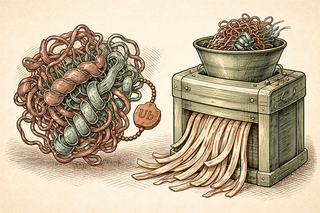
If proteins were contestants on Queer Eye, ubiquitin would be the ultimate style tag - a tiny molecular accessory that says "you've been nominated for a complete makeover." Except in biology, that makeover usually means getting shredded - literally, through the proteasome, your cell's industrial paper shredder. And it turns out, one particular molecular stylist named KLHL6 has been quietly running the most important wardrobe cull in cancer immunology.
The Exhaustion Problem (Or: When Your T Cells Turn Into Couch Potatoes)
Here's what happens when your immune system fights cancer. Your CD8+ T cells - the elite assassins of the immune world, basically the John Wick of your bloodstream - charge into battle against tumors. But tumors don't play fair. They keep waving the same annoying antigens around, day after day, like a neighbor who won't stop playing the same song on repeat. Eventually, your T cells just... give up. They stop killing. They slump on the couch, binge-watching nothing, responding to no one. Immunologists call this "T cell exhaustion," and it's one of the biggest reasons cancer immunotherapy sometimes falls flat (NCI, 2019).
The villain behind this cellular burnout? A transcription factor called TOX. Think of TOX as the hypnotist from Get Out - once it takes hold, it rewires T cells at the epigenetic level, locking them into an exhausted state where they express all the "do not disturb" signs: PD-1, LAG-3, TIM-3. The works (Scott et al., 2019, Nature Reviews Immunology).
Enter KLHL6: The Marie Kondo of Protein Disposal
In a study published in Nature, Cheng and colleagues went hunting for molecular players that could prevent this exhaustion spiral. Using computational analyses of T cell exhaustion atlases combined with in vivo CRISPR screens (because modern science is basically a Marvel montage at this point), they landed on KLHL6 - an E3 ubiquitin ligase that turned out to be doing double duty (Cheng et al., 2026, Nature).
KLHL6's first job: slap ubiquitin tags onto TOX, marking it for destruction by the proteasome. No more TOX, no more exhaustion hypnosis. It's like finding out someone invented a remote that turns off that one annoying coworker's speakerphone.
But KLHL6 doesn't stop there. Its second job targets PGAM5, a protein involved in mitochondrial dynamics. When T cells get chronically stimulated, their mitochondria - those little cellular power plants - start fragmenting like a hard drive from 2003. KLHL6 keeps PGAM5 in check, preserving mitochondrial fitness and making sure T cells keep the lights on.
As Yu, Zhuang, and Sun highlight in their Trends in Cell Biology commentary, this dual regulation through proteostasis control is what makes KLHL6 special. It's not just fighting exhaustion OR metabolic collapse. It's handling both, like a multitasking protagonist in a Christopher Nolan film operating on two timelines simultaneously (Yu et al., 2026, Trends in Cell Biology).
Why Your T Cells Lose Their Stylist
So if KLHL6 is so great, why does it disappear when we need it most? Blame chronic signaling through the T cell receptor. Persistent antigen exposure activates the PI3K-AKT pathway, which phosphorylates and sidelines FOXO1 - the transcription factor responsible for keeping KLHL6 expression humming along. It's the immunological equivalent of canceling your gym membership because you're too tired from work. The very thing making you exhausted also removes the one tool that could prevent the exhaustion (Springer Nature, 2026).
This creates a vicious feedback loop worthy of a Black Mirror episode: chronic stimulation kills FOXO1 activity, which kills KLHL6 expression, which lets TOX accumulate, which locks in the exhaustion program, which means more chronic stimulation with zero productive output.
What This Means for Cancer Therapy (The Post-Credits Scene)
The therapeutic implications read like a sequel setup. If scientists can boost KLHL6 activity - through small molecule agonists, gene therapy, or engineered protein degraders that mimic its function - they could potentially hit the reset button on exhausted T cells. Imagine giving your burned-out immune cells a Red Bull AND a therapist, simultaneously.
This is especially exciting for patients on checkpoint inhibitors like anti-PD-1 therapy, or those receiving CAR-T cells that tend to exhaust quickly in the hostile tumor microenvironment. A recent companion study even showed that proteotoxic stress responses are a hallmark of T cell exhaustion, meaning the protein quality control angle isn't just one piece of the puzzle - it might be the frame holding the whole picture together (Nature, 2025).
We're still in the early acts here - no one's injecting KLHL6 boosters into patients yet. But identifying this molecular switch gives the field a new target that addresses two problems for the price of one. And in the world of cancer immunotherapy, a two-for-one deal is about as rare and welcome as a Firefly reunion season.
References
-
Cheng, X. et al. (2026). The ubiquitin ligase KLHL6 drives resistance to CD8+ T cell dysfunction. Nature. DOI: 10.1038/s41586-025-09926-8. PMID: 41535474
-
Yu, Y., Zhuang, J., & Sun, C. (2026). Proteostasis regulation in T cell dysfunction: dual regulation by KLHL6. Trends in Cell Biology. DOI: 10.1016/j.tcb.2026.03.012. PMID: 41956857
-
Scott, A.C. et al. (2019). TOX for tired T cells. Nature Reviews Immunology, 19, 476. DOI: 10.1038/s41577-019-0193-9
-
Guo, Y. et al. (2025). Proteotoxic stress response drives T cell exhaustion and immune evasion. Nature. DOI: 10.1038/s41586-025-09539-1
-
Chronic TCR signaling-driven suppression of the FOXO1-KLHL6 axis promotes T cell exhaustion. (2025). Immunity & Inflammation, Springer Nature. DOI: 10.1007/s44466-025-00023-z
Disclaimer: The image accompanying this article is for illustrative purposes only and does not depict actual experimental results, data, or biological mechanisms.
Get cancer research delivered to your inbox
The best new studies, explained without the jargon. One email per week.