In the brutally unfair video game that is cancer, patients have been stuck grinding through the same early levels for decades - waiting for symptoms to appear, enduring invasive screening procedures, and hoping they haven't already hit a game-over screen before the first boss even shows up. But a team of Swedish researchers just dropped what might be the ultimate power-up: a blood test that spots three of the deadliest cancers using a cocktail of proteins and metabolites swirling around in your plasma.
The Villain Origin Story
Here's the setup. Colorectal cancer, lung cancer, and ovarian cancer are three antagonists with very different fighting styles but one shared superpower: they're absurdly good at hiding. Colorectal cancer has colonoscopies and stool tests keeping partial tabs on it, sure. Lung cancer has low-dose CT scans for high-risk smokers. But ovarian cancer? That one has been operating almost entirely off the radar, with no reliable early screening test at all. The CA-125 blood test that exists is about as reliable as a weather forecast three weeks out.
Meanwhile, the much-hyped Galleri test - the multi-cancer early detection darling that was supposed to change everything - stumbled hard in a massive NHS trial earlier this year, managing only 27.5% sensitivity for early-stage cancers. Fifty percent of Grail's stock value vanished faster than a speedrunner skipping cutscenes.
The quest for a better approach was wide open.
Enter the Heroes (With a Very Cool Toolkit)
Tobias Sjöblom and colleagues at Uppsala University decided to try a different strategy entirely. Instead of relying on one type of signal - like the methylation patterns Galleri uses - they went full dual-wield: proteomics plus metabolomics (Åkerrén Ögren et al., 2026).
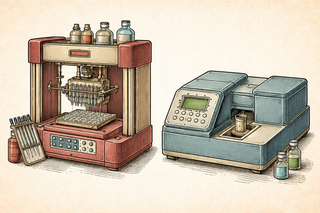
Translation for non-gamers: they measured 165 different proteins using a suspension array ELISA system (fancy automated antibody detection) AND 244 metabolites via NMR spectroscopy (basically listening to molecules vibrate in a magnetic field) across 937 people. That roster included 330 with colorectal cancer, 304 with lung cancer, 184 with ovarian cancer, and 119 healthy controls serving as the "nothing to see here" baseline.
The twist? They didn't need hundreds of markers to tell cancers apart. Panels of just two to four proteins did the heavy lifting.
The Scoreboard (And It's a Good One)
The performance numbers read like a high-score table that would make any diagnostics researcher's jaw drop:
- Cancer vs. healthy controls: ROC AUC values between 0.89 and 0.98. For context, anything above 0.90 is considered excellent, and 1.0 would be a perfect score that doesn't exist in biology.
- Distinguishing one cancer type from another: ROC AUC of 0.82 to 0.88. Not just detecting cancer, but telling you which cancer - a differential diagnosis built into the blood draw.
That second part is the real plot twist. Most liquid biopsy approaches are playing "is there cancer, yes or no?" This team's biomarkers can actually point to where in the body the trouble is brewing. It's the difference between your smoke alarm going off and your smoke alarm telling you the kitchen is on fire, not the attic.
Why This Chapter Matters
The challenges of blood-based cancer proteomics are well documented: proteins in plasma span a concentration range of about ten billion-fold, meaning the signals you want are hiding behind a wall of albumin and immunoglobulins. Finding cancer biomarkers in blood has been compared to hearing a whisper at a rock concert.
What makes this Swedish approach clever is the combination play. Proteins tell you what the body's cells are making. Metabolites tell you what those cells are doing. Together, they paint a richer portrait than either alone - like getting both the security camera footage and the audio transcript of the crime.
The multi-cancer early detection field is at a crossroads. The cfDNA methylation approach that dominated headlines has shown its limitations in real-world trials. Proteomic and metabolomic panels like this one offer a complementary - or possibly superior - path, especially for cancers where early-stage sensitivity has been the Achilles' heel.
The Cliffhanger
Before anyone starts printing "CANCER DEFEATED" t-shirts: this study is a case-control design, which means the researchers already knew who had cancer and who didn't. The real boss fight - a prospective screening trial in people who don't know their status yet - hasn't happened. Performance in the wild is almost always humbler than in the lab.
But the ingredients are tantalizing. A minimally invasive blood draw. A small, interpretable panel of markers. Strong discrimination not just between sick and healthy, but between different cancer types. And it outperforms existing FDA-approved tests on paper.
The next level awaits. And for the first time in a while, the players have a power-up worth getting excited about.
References
-
Åkerrén Ögren, J., Ekström, J., Rameika, N., et al. (2026). Composite proteomic and metabolomic plasma biomarkers for detection of colorectal, lung and ovarian cancers. Molecular Cancer. DOI: 10.1186/s12943-026-02654-1. PMID: 41943016
-
Banerjee, S., et al. (2020). Challenges and Opportunities in Clinical Applications of Blood-Based Proteomics in Cancer. Cancers, 12(9), 2428. PMCID: PMC7564506
-
Bhatia, S., et al. (2024). Technology and Future of Multi-Cancer Early Detection. Journal of Clinical Medicine, 13(14), 4176. PMCID: PMC11277619
-
Neal, R.D., et al. (2026). Galleri multi-cancer early detection test: NHS-Galleri trial results. Reported in Cancer Health and STAT News
-
Hoffman, R.M., et al. (2025). Multicancer early detection testing: Guidance for primary care discussions with patients. Cancer. DOI: 10.1002/cncr.35823
Disclaimer: The image accompanying this article is for illustrative purposes only and does not depict actual experimental results, data, or biological mechanisms.