The new paper by Zhang and colleagues takes aim at that exact post-op problem with a very sneaky-sounding invention: an injectable "Trojan horse" hydrogel placed where the tumor used to be (1). The idea is simple enough to explain over fries and complicated enough to make cancer biology look like it needs adult supervision.
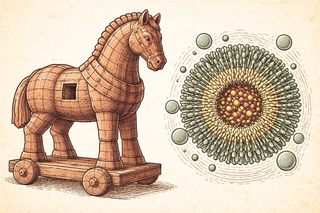
Here is the setup. After surgery, the cavity where the tumor sat becomes a weird neighborhood. Residual cancer cells remain scattered in brain tissue. The local immune scene is also deeply unhelpful, with macrophages often pushed into a tumor-friendly mood instead of their usual trash-collector, intruder-eater job. Glioblastoma is excellent at this kind of environmental corruption. If tumors had LinkedIn profiles, this one would list "microenvironment management" under special skills.
So the researchers built a dual-cross-linked hydrogel from modified Pluronic F127 and paclitaxel, a chemotherapy drug. Instead of just sitting there like a sad blob of medicine, the gel slowly breaks down and releases tiny paclitaxel-bearing micelles. Those micelles are small enough to move through brain tissue more effectively than a big static depot. That matters because glioblastoma recurrence is not just a "one lump in one spot" story. It is more like a bad franchise with spinoffs.
Why the tiny escape artists matter
This is where the paper gets clever. The micelles are designed to do two jobs at once.
First, they hit residual tumor cells directly with paclitaxel. That is the straightforward chemo part.
Second, they seem to push macrophages away from their usual tumor-coddling behavior and back toward actually engulfing things they should be engulfing. In other words, the treatment is not only throwing punches at cancer cells, it is also trying to get the local immune bouncers to remember whose side they are on. That is a big deal in glioblastoma, where macrophages and microglia are major players in the tumor microenvironment and often help the disease persist, adapt, and resist therapy (2, 3).
The anti-CD47 combination makes the strategy even more interesting. CD47 is one of cancer's classic "don't eat me" signals. Block it, and macrophages become more willing to swallow tumor cells rather than nod politely and let them continue their villain monologue. Wikipedia gets the core idea right here: CD47 helps cells avoid phagocytosis, and tumors exploit that trick shamelessly. In this study, combining the gel with anti-CD47 antibody pushed long-term survival in the mouse model to 66.7%, compared with 50% for the gel formulation alone (1).
Cancer, unfortunately, reads Darwin too
What makes this paper fun in the darkest possible scientific way is that it treats glioblastoma like the evolutionary arms race it is. Surgery changes the landscape. The surviving cells are the ones best positioned to regrow. The immune environment often gets bent in favor of the survivors. A local hydrogel that releases penetrating nanomicelles and reprograms macrophages is basically an attempt to alter the fitness landscape right after surgery, before the remaining rebels can reorganize.
That broader logic fits with other recent work. Researchers have been exploring post-resection hydrogels that turn the surgical cavity into a hostile zone for recurrence, including immune-stimulating biomaterials and signal-amplifying gel systems that recruit and activate antitumor immunity (4, 5). There is also growing clinical interest in macrophage-reprogramming therapies more broadly, although translating them cleanly into patients remains a serious challenge (6).
The catch, because there is always a catch
Before anybody starts writing "glioblastoma solved" on a whiteboard, this is still preclinical work in mice. Brain tumors have a long history of humiliating treatments that looked sharp in animal models and then face-planted in humans. The human brain, the human immune system, and the post-surgical realities of actual patients are all less cooperative than lab diagrams.
Still, this paper tackles a very real bottleneck. Glioblastoma does not usually lose because doctors forgot to care. It wins because residual cells are invasive, the brain is hard to drug, and the immune setting around the tumor often behaves like a compromised security team. This hydrogel tries to solve all three at once: stay local, spread small, and make the macrophages less gullible.
That is not a final verdict. But for a disease that keeps exploiting every ecological loophole it can find, it is a smarter argument than just throwing more drug at the problem and hoping the tumor forgets how recurrence works.
References
-
Zhang X, Luo J-Q, Pan Y-N, Han S-Y, Zhang T, Liu X-Y, Xie W-C, Zhou Z-H, Du X-J, Du J-Z. Injectable Trojan Horse Hydrogel Unleashing Penetrable and Immunostimulatory Nanomicelles for Postoperative Treatment of Glioblastoma. ACS Nano. 2026. DOI: 10.1021/acsnano.6c03253
-
Khan F, Pang L, Dunterman M, Lesniak MS, Heimberger AB, Chen P. Macrophages and microglia in glioblastoma: heterogeneity, plasticity, and therapy. Journal of Clinical Investigation. 2023;133(1):e163446. DOI: 10.1172/JCI163446
-
Li X, Graeber MB. Microglia and macrophages in glioblastoma: landscapes and treatment directions. The FEBS Journal. 2024. DOI: 10.1002/1878-0261.13657
-
Zhang J, Chen C, Li A, et al. Immunostimulant hydrogel for the inhibition of malignant glioma relapse post-resection. Nature Nanotechnology. 2021;16:538-548. DOI: 10.1038/s41565-020-00843-7
-
Qiu Q, Chen S, He H, et al. An injectable signal-amplifying device elicits a specific immune response against malignant glioblastoma. Acta Pharmaceutica Sinica B. 2023;13(12):5091-5106. DOI: 10.1016/j.apsb.2023.06.010. PMCID: PMC10692361
-
Dusoswa SA, Mantovani A, Allavena P. Clinical landscape of macrophage-reprogramming cancer immunotherapies. British Journal of Cancer. 2024;131:627-640. DOI: 10.1038/s41416-024-02715-6
Disclaimer: The image accompanying this article is for illustrative purposes only and does not depict actual experimental results, data, or biological mechanisms.