```markdown
title: "The Double Agent in Your Liver: How Immunotherapy is Running Covert Ops Against Liver Cancer"
slug: nivolumab-ire-nivolep-hcc
date: 2026-04-15
tags: [hepatocellular carcinoma, immunotherapy, nivolumab, irreversible electroporation, ablation, NIVOLEP]
The Double Agent in Your Liver: How Immunotherapy is Running Covert Ops Against Liver Cancer
The intelligence report landed on the desk marked CLASSIFIED: a rogue cell network had gone dark inside the liver, evading every surveillance system the body had deployed. Standard counterintelligence - burning the site with thermal ablation - kept failing, with over half the targets reappearing within a year. So a French research team did what any good spy agency would do: they sent in a double agent before the raid, wired the perimeter with electrical traps, and then kept an operative embedded for a full year after. The codename? NIVOLEP.
The Problem: Liver Tumors That Just Won't Stay Dead
Hepatocellular carcinoma (HCC) is the most common primary liver cancer and the third leading cause of cancer death worldwide. For patients with early-stage disease - what clinicians call BCLC stage A - the standard play is to destroy the tumor with ablation. Heat it up, freeze it out, zap it gone.
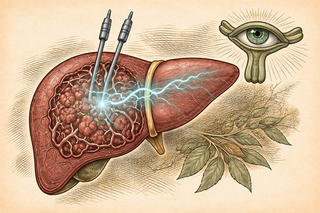
But here's where the skeptic in me kicks in: for tumors that are tricky to reach, sitting near blood vessels or bile ducts where heat-based methods would cause collateral damage, there's a technique called irreversible electroporation (IRE). IRE uses short, high-voltage electrical pulses to punch permanent holes in cancer cell membranes - basically death by a thousand tiny doors that won't close. It spares the surrounding architecture (blood vessels, nerves, ducts) because the structural collagen scaffolding doesn't care about electric fields. Elegant, right?
The catch: IRE's local recurrence rate sits above 50% at one year. More than half the tumors come crawling back. That's not a cure - that's a speed bump.
Enter the Double Agent: Nivolumab Before and After
The NIVOLEP trial (NCT03630640), a multicenter phase 2 study across France, asked a genuinely interesting question: what if you prime the immune system before you electrocute the tumor, then keep it running surveillance after?
Here's the playbook: 43 patients with early-stage HCC received two doses of nivolumab (an immune checkpoint inhibitor that essentially takes the brakes off your T cells) before IRE. Then, after the electrical assault, they got 12 monthly nivolumab infusions as an adjuvant - a long-term undercover operation to catch any tumor cells plotting a comeback (Nahon et al., 2025).
Now, before we pop champagne: this is a phase 2 trial with 43 patients and no control arm. I've seen too many "breakthrough" headlines from single-arm studies that quietly fizzled in phase 3. So let's look at the numbers with appropriately raised eyebrows.
The Intel Report: What Actually Happened
Of the 43 enrolled patients (mean age 71, 88% male, 81% with cirrhosis - a tough crowd medically), 35 made it through to curative IRE. Eight didn't: four had IRE failures, three had disease progression, and one died. That attrition matters.
Among those who got the full treatment across 62 tumor nodules (mean size: 30mm):
- One-year local recurrence-free survival: 70.6% (95% CI: 55.3-85.9). Compare that to the historical >50% recurrence rate with IRE alone. That's a meaningful improvement, even if the confidence interval is wide enough to drive a truck through.
- Two-year overall survival: 74.2% in intention-to-treat analysis.
- Neoadjuvant response: Before IRE even happened, 24.2% of nodules showed radiological shrinkage and 26.3% showed pathological response to nivolumab alone. The immunotherapy was already picking fights with the tumor before the electricians showed up.
The molecular espionage was equally telling. RNA sequencing of tumors after neoadjuvant nivolumab revealed increased activity in pathways linked to immune cell migration, T cell activation, and CD8+ T cell and B cell infiltration - specifically in tumors that responded pathologically. Translation: nivolumab was successfully calling in reinforcements before the main assault (Nahon et al., 2025).
The Cost of Doing Business
No free lunches in oncology. Grade 3 or 4 nivolumab-related adverse events hit two patients, and one patient died from nivolumab toxicity. Checkpoint inhibitors in a cirrhotic liver population carry real risk - these are patients whose immune systems are already operating on a complicated background. That one death is not a footnote; it's a reminder that immune activation is a double-edged sword.
Why the Skeptic is Cautiously Intrigued
Here's what makes this more than just another small phase 2 story. The biological rationale is sound: IRE, unlike thermal ablation, preserves tumor antigens and structural proteins because it doesn't cook the tissue. That intact antigen exposure, combined with immune checkpoint blockade, creates a scenario where the immune system gets a clear look at the enemy and permission to attack. Recent research into IRE's immunological effects has shown it triggers immunogenic cell death and releases damage-associated molecular patterns - basically flare guns that attract immune cells to the battlefield (Lin et al., 2024).
The broader perioperative immunotherapy landscape in HCC is heating up, with trials like IMbrave050 testing atezolizumab plus bevacizumab after resection or ablation. But NIVOLEP is unusual in targeting the neoadjuvant window specifically for IRE - a technique that desperately needs a partner because its solo recurrence numbers are frankly embarrassing (Kole et al., 2025).
The Bottom Line
NIVOLEP isn't going to rewrite textbooks tomorrow. It's a small, single-arm trial that needs randomized validation before anyone should get too excited. But the combination of a ~30% improvement in local recurrence-free survival, documented immune activation in tumor tissue, and a biologically plausible mechanism puts it in the "worth watching closely" category rather than the "file and forget" pile.
The spy metaphor isn't even much of a stretch here: the immune system was being suppressed by the tumor microenvironment, nivolumab reactivated the agents, IRE blew open the safe house, and the extended adjuvant course maintained surveillance. Whether this covert operation scales up to a full campaign remains the billion-dollar question.
References
-
Nahon P, Ziol M, Pan L, et al. Neoadjuvant and adjuvant nivolumab associated with irreversible electroporation in patients with BCLC A hepatocellular carcinoma and high risk of recurrence (NIVOLEP trial). Hepatology. 2025. DOI: 10.1097/HEP.0000000000001764. PMID: 41950497
-
Lin M, Zhang X, Liang S, et al. Leveraging the immunological impacts of irreversible electroporation as a new frontier for cancer therapy. Annual Review of Chemical and Biomolecular Engineering. 2024. DOI: 10.1146/annurev-chembioeng-082223-054259
-
Kole C, Charalampakis N, Vailas M, et al. Neoadjuvant immune checkpoint inhibitors for hepatocellular carcinoma. npj Precision Oncology. 2025. DOI: 10.1038/s41698-025-00846-4
-
Li Y, Ma Y, Wu Z, et al. Perioperative immunotherapy for hepatocellular carcinoma: adjuvant, neoadjuvant, and biomarker-guided strategies. Frontiers in Medicine. 2026. DOI: 10.3389/fmed.2026.1811918
-
ClinicalTrials.gov. Neoadjuvant and adjuvant nivolumab in HCC patients treated by electroporation (NIVOLEP). Identifier: NCT03630640
Disclaimer: The image accompanying this article is for illustrative purposes only and does not depict actual experimental results, data, or biological mechanisms.