Cellular engineering in stomach cancer can look like a home renovation that went off the rails - the sealant cracked, the wall got peeled back, and suddenly the pipes you were never supposed to see are sticking out for the whole neighborhood. That, in a very strange little nutshell, is why claudins have become such a hot target in gastric cancer. Scientists found that one of these proteins, called claudin 18.2, often gets exposed when stomach cells turn cancerous. Once that hidden bit is out in the open, a drug can grab it like a handyman finally spotting the busted valve.
The new review by Balsa and colleagues takes stock of this whole claudin story, especially CLDN18.2 and its weirder cousin CLDN6, and asks whether these proteins can help doctors match the right patients to the right treatments in gastric cancer [1].
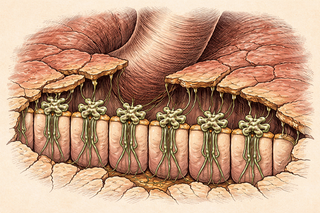
The stomach’s grout has entered the chat
Claudins are part of the tight junction system, which is basically the grout and seal around epithelial cells. In a healthy stomach, CLDN18.2 sits tucked inside those junctions, minding its own business. Cancer, being the culinary disaster that it is, tears up the recipe and the backsplash at the same time. When the tissue architecture falls apart, CLDN18.2 becomes exposed on the tumor cell surface, where drugs can finally reach it [1,2].
That matters because stomach cancer has long been a frustrating kitchen to work in. A lot of patients are diagnosed late, the menu of biomarkers has been limited, and treatment decisions can feel like trying to cook dinner with half the labels peeled off the spice jars. CLDN18.2 gives oncologists one more label they can actually read.
From pantry inventory to actual dinner
The star drug here is zolbetuximab, an antibody that sticks to CLDN18.2 and helps the immune system attack those cancer cells. Two phase 3 trials moved this from “interesting idea” to “this is now on the menu.”
In SPOTLIGHT, adding zolbetuximab to mFOLFOX6 improved median progression-free survival to 10.6 months vs 8.7 months compared with chemotherapy alone [3,6]. In GLOW, zolbetuximab plus CAPOX improved progression-free survival to 8.21 months vs 6.80 months and overall survival to 14.39 months vs 12.16 months [4]. That is not magic. It is not a movie montage with triumphant violins. But in metastatic gastric cancer, a couple extra months of disease control or survival is real table stakes for real people.
That evidence helped lead to FDA approval on October 18, 2024 for zolbetuximab with chemotherapy in first-line, HER2-negative, CLDN18.2-positive advanced gastric or gastroesophageal junction adenocarcinoma [6]. So this is no longer just lab-bench chatter over bad conference coffee.
Why this is exciting, and why nobody gets to spike the football yet
The fun part is that CLDN18.2 opens a whole pantry shelf of future options. Beyond plain antibody therapy, researchers are testing antibody-drug conjugates, bispecific antibodies, and CAR-T cells aimed at claudins [1,2]. One phase 1 study of the CLDN18.2-targeting ADC IBI343 reported a confirmed response rate of 29% and median progression-free survival of 5.5 months in patients with CLDN18.2-high gastric or gastroesophageal cancer [5]. A newer phase 2 trial combining zolbetuximab, chemotherapy, and nivolumab posted an objective response rate of 62.1% in measurable disease, which is the sort of number that makes oncologists sit up straighter in their chairs [7].
Then there is CLDN6, an oncofetal protein that is mostly switched off in adult tissues but can reappear in some tumors. That makes it appealing in the same way an old family recipe card surfacing in the wrong cookbook would get your attention. It should not be there, so maybe it is useful to target [1].
But the annoying part, because cancer biology always insists on leaving flour on every surface, is heterogeneity. Not every tumor cell expresses the same amount of CLDN18.2. One biopsy sample might say “yes,” another part of the same tumor might whisper “eh, sort of,” and metastatic sites can differ too. Add inconsistent testing methods and uncertain cutoffs, and you have a recipe where three cooks are using three measuring cups and arguing about what counts as a tablespoon [1,2].
There is also toxicity. Zolbetuximab commonly brings nausea and vomiting, which makes cruel sense because the target lives in gastric tissue. When your therapy works by tagging a stomach-linked protein, the stomach may file a loud complaint [4,6].
The big takeaway, without the lab-coat voice
This paper’s main point is simple: claudins are turning gastric cancer from a one-size-fits-nobody disease into something a bit more tailored. If CLDN18.2 testing becomes more reliable, and if next-generation claudin drugs keep working in bigger trials, more patients could get treatments based on what their tumors are actually displaying, not just where the cancer started [1,2].
That is the appeal here. Not a miracle casserole. Just a smarter kitchen, better ingredients, and fewer guesses.
References
- Balsa M, Alonso S, Sánchez L, et al. Targeting claudins in gastric cancer: A novel GLOWing strategy in the SPOTLIGHT. Cancer Treatment Reviews. 2026;103141. DOI: https://doi.org/10.1016/j.ctrv.2026.103141
- Nakayama I, Qi C, Chen Y, Nakamura Y, Shen L, Shitara K. Claudin 18.2 as a novel therapeutic target. Nature Reviews Clinical Oncology. 2024. DOI: https://doi.org/10.1038/s41571-024-00874-2
- Shitara K, Lordick F, Bang YJ, et al. Zolbetuximab plus mFOLFOX6 in patients with CLDN18.2-positive, HER2-negative, untreated, locally advanced unresectable or metastatic gastric or gastro-oesophageal junction adenocarcinoma (SPOTLIGHT): a multicentre, randomised, double-blind, phase 3 trial. The Lancet. 2023;401(10389):1655-1668. DOI: https://doi.org/10.1016/S0140-6736(23)00620-7
- Shah MA, Shitara K, Ajani JA, et al. Zolbetuximab plus CAPOX in CLDN18.2-positive gastric or gastroesophageal junction adenocarcinoma: the randomized, phase 3 GLOW trial. Nature Medicine. 2023;29(8):2133-2141. DOI: https://doi.org/10.1038/s41591-023-02465-7. PMCID: https://pmc.ncbi.nlm.nih.gov/articles/PMC10427418/
- Liu J, Yang J, Sun Y, et al. CLDN18.2-targeting antibody-drug conjugate IBI343 in advanced gastric or gastroesophageal junction adenocarcinoma: a phase 1 trial. Nature Medicine. 2025;31:3028-3036. DOI: https://doi.org/10.1038/s41591-025-03783-8. PMCID: https://pmc.ncbi.nlm.nih.gov/articles/PMC12443601/
- U.S. Food and Drug Administration. FDA approves zolbetuximab-clzb with chemotherapy for gastric or gastroesophageal junction adenocarcinoma. October 18, 2024. https://www.fda.gov/drugs/resources-information-approved-drugs/fda-approves-zolbetuximab-clzb-chemotherapy-gastric-or-gastroesophageal-junction-adenocarcinoma
- Shah MA, et al. First-line zolbetuximab plus mFOLFOX6 and nivolumab in unresectable CLDN18.2-positive gastric or gastroesophageal junction adenocarcinoma: a phase 2 trial. Nature Medicine. 2026. DOI: https://doi.org/10.1038/s41591-026-04306-9
Disclaimer: The image accompanying this article is for illustrative purposes only and does not depict actual experimental results, data, or biological mechanisms.